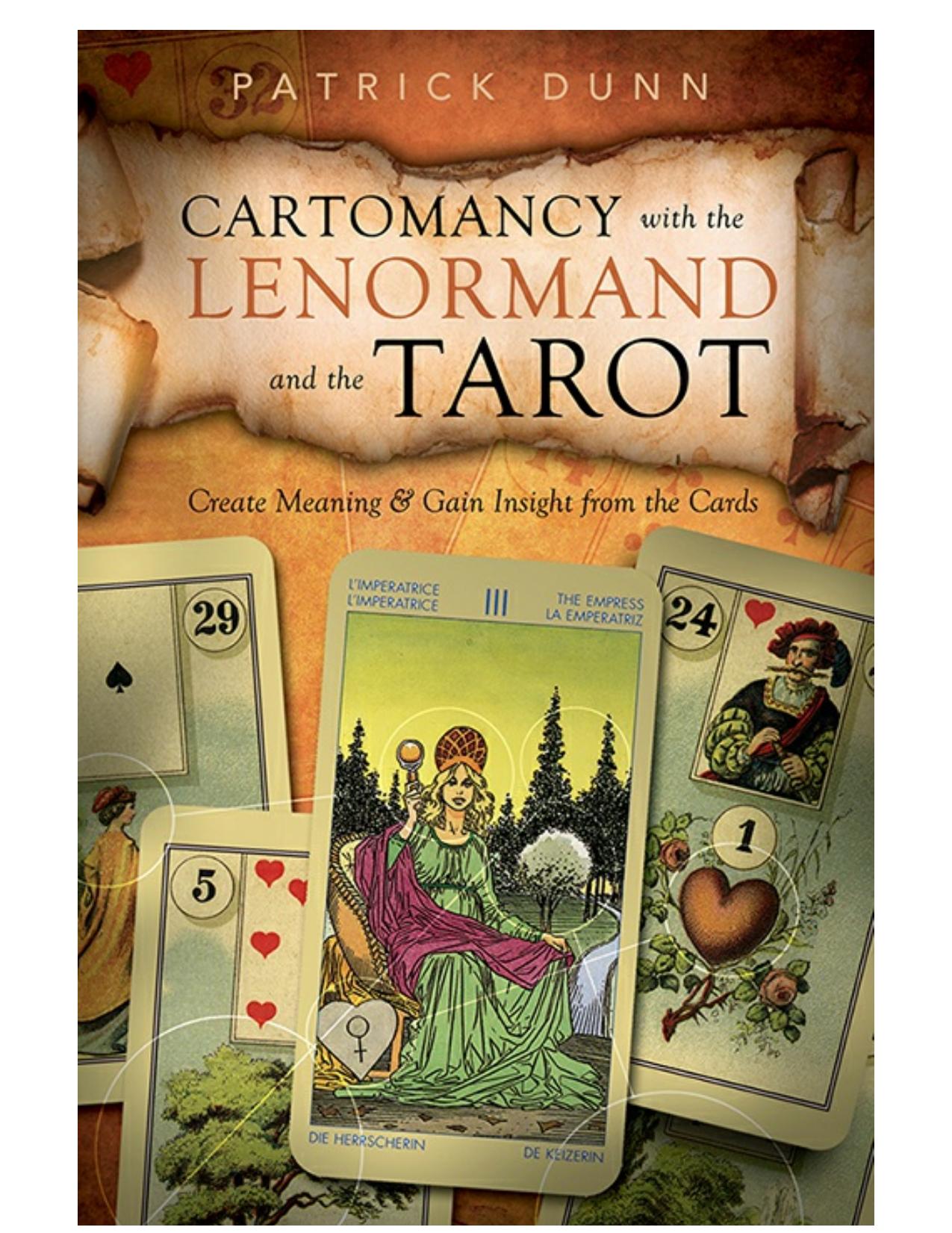
Cartomancy with the Lenormand and the Tarot by Patrick Dunn
Author:Patrick Dunn
Language: eng
Format: epub, pdf
Tags: lenormand, card, cards, reading, French, fortune-telling, fortune telling, tarot, tarot reading, tarot reader, salon-style, theory
Publisher: Llewellyn Worldwide, LTD.
Published: 2013-05-12T16:00:00+00:00
[contents]
21. Eliphas Levi, Transcendental Magic (Boston, MA: Weiser, 1968), 349–350.
22. Juan García Ferrer, El Método Lenormand: Todo Sobre las Cartas Lenormand (n.l. self-published, 2008), 42.
Chapter XI
Intuitive Reading
Here’s the bit of the book where I launch into the woo-woo. I obviously don’t think it’s woo-woo; on the contrary, while I’m a staunch advocate for rational thinking (there’s too little of it; too few people know how to do it; and those who claim it rarely practice it), I also think there’s a place for the nonrational. Note that the nonrational isn’t the irrational. Rather than the opposite of rational thinking, it’s the complement to it.
We can divide rational thinking into two ways of reasoning: deduction and induction. Similarly, we can identify nonrational thinking as comprised of a third: abduction. Deductive reasoning is mathematical in nature: it arrives at a conclusion that necessarily follows from given premises. Induction is scientific: it arrives at conclusions based upon weighing evidence. Both involve analysis, the process of breaking ideas into their parts. Abduction, in contrast, is the perception of patterns and the creation of meaning from those patterns holistically. Where both deduction and induction analyze patterns into their components, when we use abduction we perceive the patterns as a whole.
When we read the cards, we don’t abandon analysis: we analyze the cards and their places to narrow down a range of possible meanings. For some readers, this analysis is all they do: the beginner frantically flipping through the book and reading the “meanings” of the cards is performing a kind of analysis. It has value, to be sure, or no beginner would ever move beyond those beginnings.
However, skilled readers shoud use abduction, too. Abduction isn’t a mystical process; nearly every scientist begins with an abduction. Let’s imagine that I’m investigating a scientific problem. I notice that the current theories of, say, syntax don’t quite work for me. I can’t put my finger on it, but I have a hunch that it works some other way. This hunch, which leads to potential hypotheses, is abductive reasoning. I have seen the pattern and “felt” that it doesn’t fit. Now, as a scientist, I design procedures by which I can try to falsify my hunch, leading me into the city streets of induction and deduction.
But let’s imagine that we remain in the twisty forest path of abductive reasoning for a while longer. Scientists use this tool only to find things to investigate, but can we use it as a means of investigation itself? Can we use it to create meaning?
Poets and artists use abductive reasoning all the time. A poem begins—at least for me—in a felt sense of rightness about a phrase or a few words. I might have two phrases, know that they must be separated, that I must move from one to the other, but know nothing else. Then, word by word, phrase by phrase, on a good day clause by clause, I find the rest of the poem.
So how do we
Download
Cartomancy with the Lenormand and the Tarot by Patrick Dunn.pdf
This site does not store any files on its server. We only index and link to content provided by other sites. Please contact the content providers to delete copyright contents if any and email us, we'll remove relevant links or contents immediately.
Becoming Supernatural by Dr. Joe Dispenza(8223)
Crystal Healing for Women by Mariah K. Lyons(7932)
The Witchcraft of Salem Village by Shirley Jackson(7277)
Inner Engineering: A Yogi's Guide to Joy by Sadhguru(6798)
The Four Agreements by Don Miguel Ruiz(6767)
The Power of Now: A Guide to Spiritual Enlightenment by Eckhart Tolle(5788)
Secrets of Antigravity Propulsion: Tesla, UFOs, and Classified Aerospace Technology by Ph.D. Paul A. Laviolette(5373)
The Wisdom of Sundays by Oprah Winfrey(5165)
Room 212 by Kate Stewart(5129)
Pale Blue Dot by Carl Sagan(5012)
Fear by Osho(4741)
The David Icke Guide to the Global Conspiracy (and how to end it) by David Icke(4721)
Animal Frequency by Melissa Alvarez(4474)
Rising Strong by Brene Brown(4465)
How to Change Your Mind by Michael Pollan(4358)
Sigil Witchery by Laura Tempest Zakroff(4248)
Man and His Symbols by Carl Gustav Jung(4138)
The Art of Happiness by The Dalai Lama(4132)
Real Magic by Dean Radin PhD(4129)
